
A special environment creates special life
In the constant mist of the water spray, there is a botanical niche. Here, where the light is perfect and the humidity never drops, special species have made their home – species that completely depend on this unique environment.
What is life like in the mist of a waterfall, and why is it under such serious threat? Join botanists in this short film as they search for the hidden treasures of our waterfalls.
The Sunnmørsmarikåpe – A botanical treasure from Møre og Romsdal
As a highly localized endemic species, the Sunnmørsmarikåpe (Alchemilla semidivisa) is of particular botanical importance: it was only discovered in 1989, officially described in 2005, and is found exclusively in a tiny part of Norway. Its entire range is limited to just 150 km² in Møre og Romsdal, with the area where its presence has actually been confirmed covering a mere 56 km². As Norway bears sole global responsibility for the species, it is classified as Endangered in the 2021 Red List of Norway.
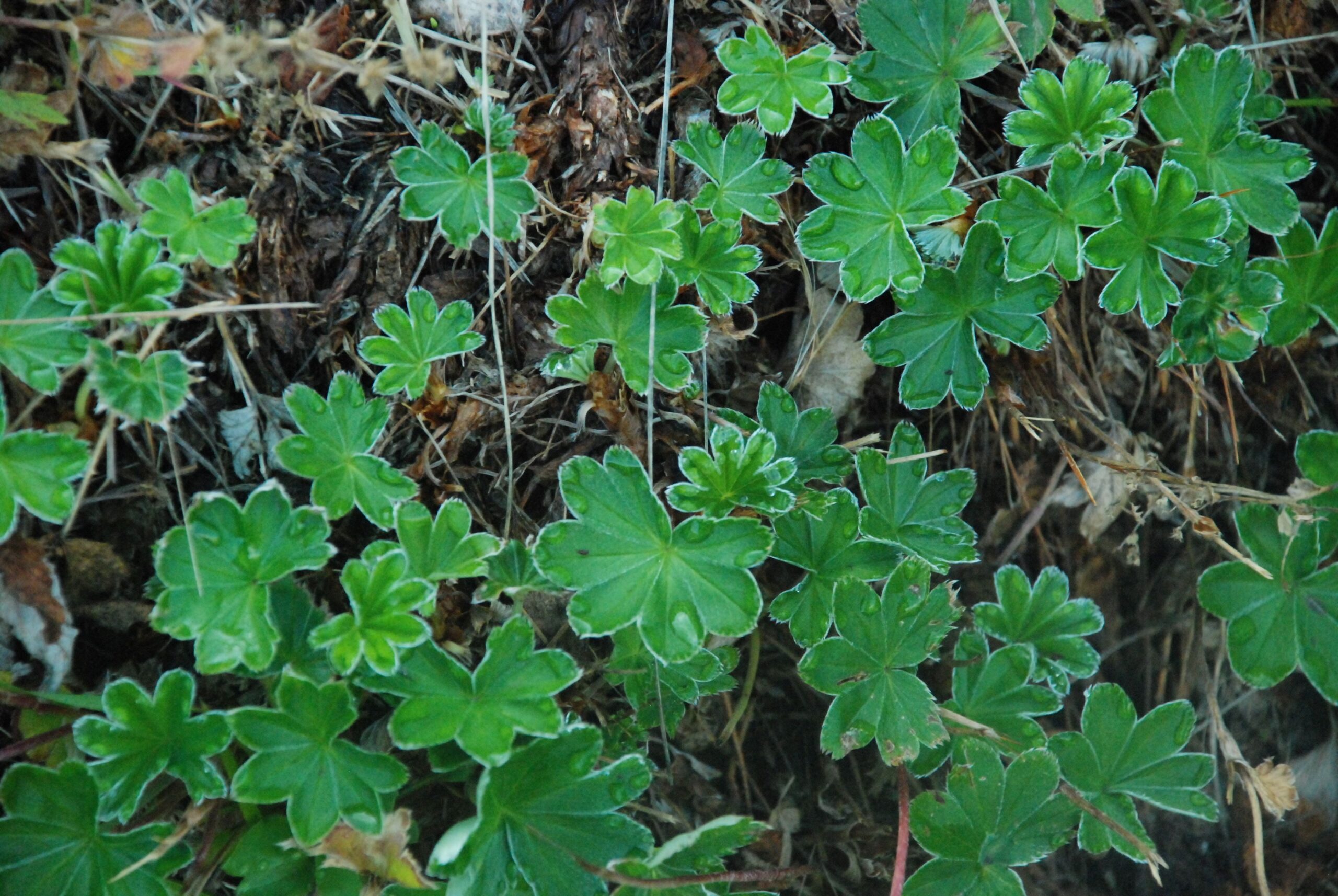
This small, unassuming plant is perfectly adapted to an extreme environment: it grows on open, treeless rocky outcrops and is absolutely dependent on constant, extremely high humidity and the spray from waterfalls or fast-flowing streams. It is found mainly in two areas, as well as a few isolated satellite sites.
The spray from a waterfall in Geiranger creates special microclimatic conditions here. Video: Aaron Hager
Threats & Conservation
The greatest threat comes from hydroelectric regulation, which deprives the waterfalls of the mist the plants need to survive. Dense spruce plantations, climate change and direct interference with the natural environment also threaten these small populations. However, a survey in 2020 brought hope: a total of around 4,660 individual plants were counted at 12 of 28 sites – including seven new discoveries.
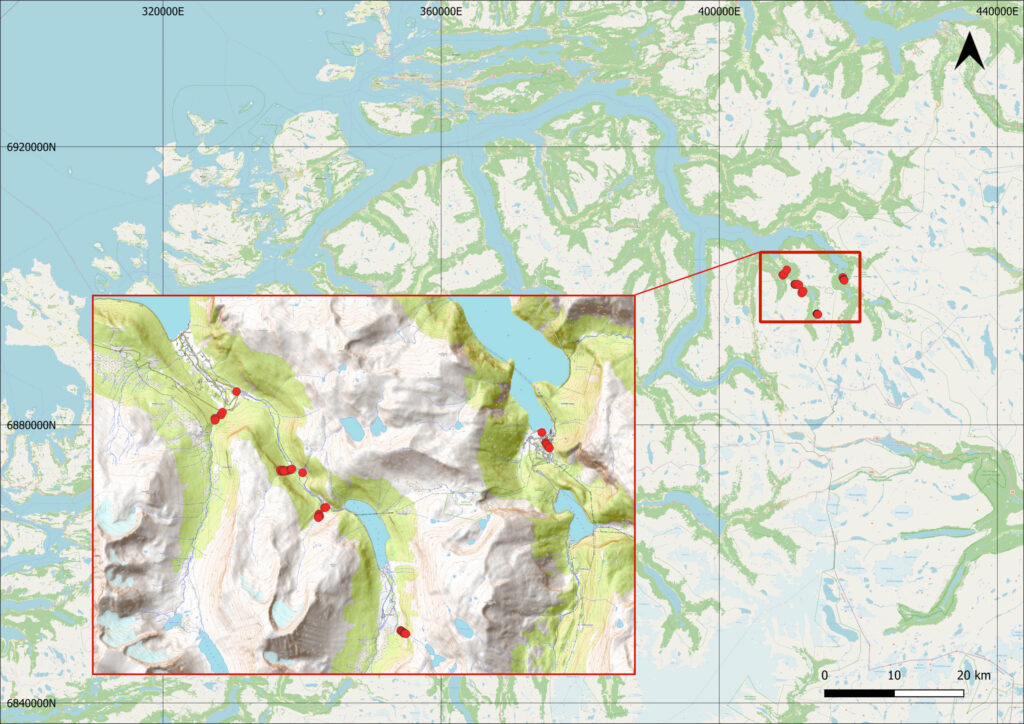
Distribution and survey locations of the Sunnmørsmarikåpe (Alchemilla semidivisa) in the Norddal, Herdalen, and Tafjord regions. The map displays the recorded plant occurrences from the 2020 field mapping. Basemap: OpenStreetMap / OpenTopoMap; Coordinate System: WGS 84 / UTM Zone 32N (EPSG:32632); cartography and custom design: Aaron Hager, created with QGIS (04.06.2026), based on data from Jordal (2020).
Endemic Species
In biology, species are described as endemic if they are found exclusively in a very specific, geographically distinct region. A well-known example of an endemic species is the kangaroo in Australia.
When a plant is described as “endemic to Sunnmøre”, this means that it exists nowhere else on Earth – no other continent, no other country and no other region of Norway shares this biological treasure.
How do endemic species arise?
The emergence of endemic species (endemisation) is always based on the principle of isolation. Over long periods of time, populations evolve along their own distinct paths:
Ecological niches
When a location offers extreme and unique conditions (such as the constant mist from a waterfall), only absolute specialists can survive there. They diverge from their parent species and can no longer exist outside this niche.
Geographical barriers
Steep fjord walls, deep valleys and high mountain passes act like walls. Whatever is trapped here continues to evolve in isolation from the rest of the world – much like on a desert island in the ocean or an isolated ‘island mountain’ rising out of a flat plain.
Geological time capsules
During the ice ages, almost all of Northern Europe was covered by glaciers. Primitive plants survived on some ice-free mountain peaks (nunataks) or in sheltered coastal strips of the fjords. After the ice melted, these ancient specialists remained in their cold, damp niches, whilst they were displaced everywhere else.
References
Artsdatabanken. Alchemilla semidivisa. Retrieved June 16, 2026, from https://artsdatabanken.no/arter/takson/63202
Holtan, D., & Ericsson, S. (2013). Status for Sunnmørsmarikåpe Alchemilla semidivisa Ericsson. Blyttia, 71(1), 5–10.
Jordal, J. B. (2020). Kartlegging og overvåking av sunnmørsmarikåpe (Alchemilla semidivisa) i Møre og Romsdal i 2020 (Rapport MU2020-42). Miljøfaglig Utredning.
Written by Aaron Hager with the help of AI